
If you’re doing good work but prospects still don’t “get it” quickly, you don’t have a marketing problem. You have a positioning problem.
This workshop is designed to align your leadership team on clear positioning decisions and turn them into messaging your team can actually use in market.
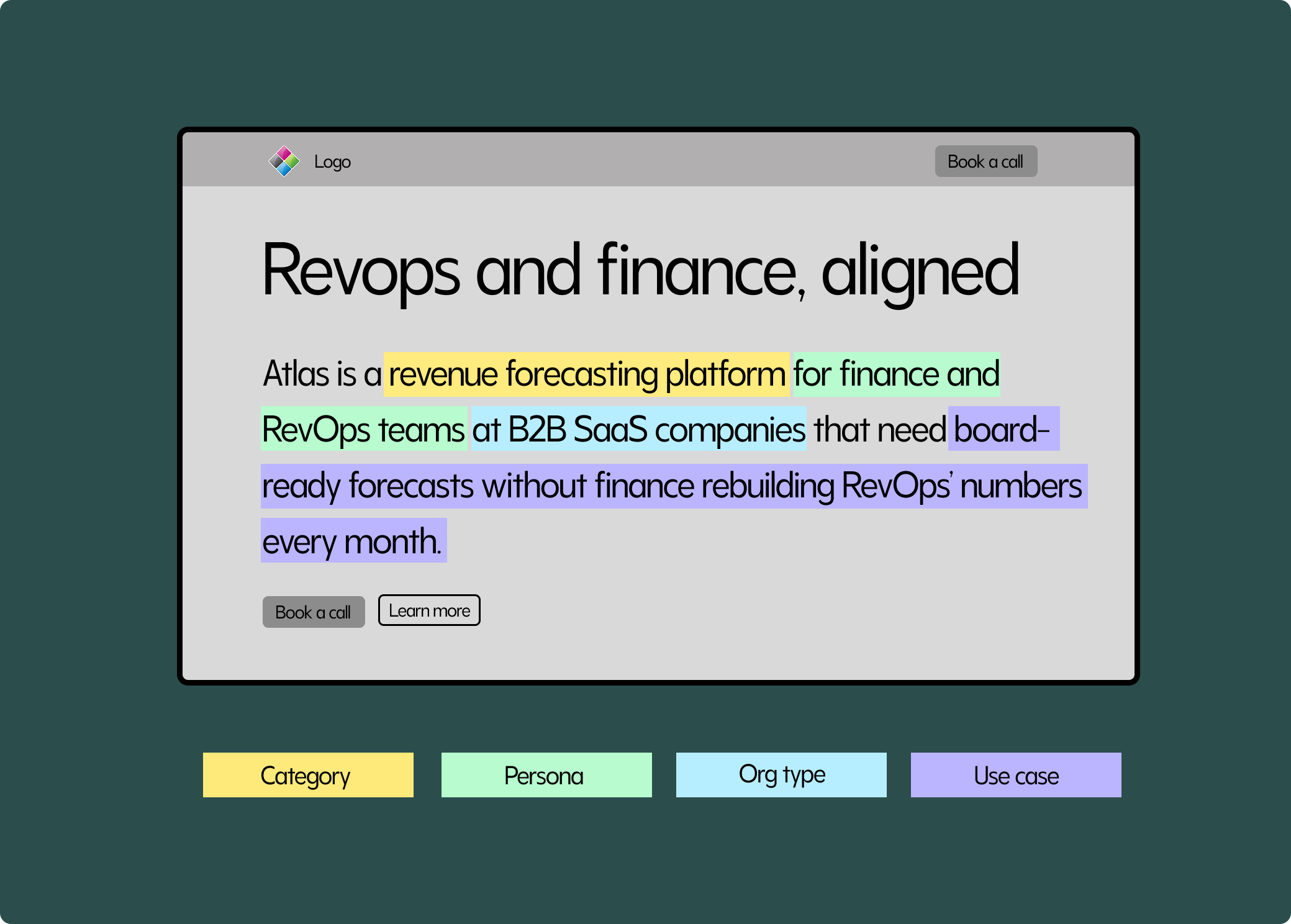
People read your website but don’t understand what you do
People get what you do, but not why they should pick you over alternatives
Sales and marketing tell different stories
You’re chasing multiple segments and can’t prioritise
You keep saying you “need to educate the market”
You’ve got multiple products and can’t explain the suite simply
You’re losing deals to “we’ll stick with what we’re doing”
If any of those are true, a workshop is the fastest way to get to clarity.
I help founders and small marketing teams get clear on their market position, so they can resonate with laser-focused messaging, and can get clear on their product strategy.

I gather the raw material we’ll need to make good positioning decisions, fast. I look at:
This gives us a shared fact base so the workshop isn’t just opinions and internal politics.
We get the right people in the room and make the hard calls together. I’ll ask you to bring:
In the workshop, I facilitate a structured conversation to decide:
Optional: if you’re in/around London, we can do this in person (it’s usually faster for alignment).
I turn the discussion into a clear, usable positioning document your whole team can work from. You’ll get a written doc that captures:
This becomes the foundation for your website, sales motion, and future campaigns.
If you want, I’ll help you ship the new positioning into market so it actually changes outcomes. Optional deliverables include:
This is where positioning stops being a document and starts showing up in pipeline.
This is best for B2B Saas/AI companies where...
Unlike physical products, software can be used in a variety of ways, by a variety of people. The challenge of finding the most valuable usecase, for the persona that loves it most isn’t easy. But the rewards are huge, with most B2B companies blending into a sea of sameness. Highlighting your unique value is key for companies to grow faster.
A B2B positioning project is a structured process designed to align your product, market, and messaging around a clear, defensible point of view, so buyers quickly understand why you’re different and why it matters.In practice, the project typically involves four stages:
1. Discovery and research - This includes reviewing your existing website, messaging, sales materials, CRM data, customer interviews or call recordings, and competitor positioning. The goal is to understand how you’re currently perceived and where confusion or overlap exists.
2. Stakeholder alignment - Key stakeholders are brought together to surface assumptions, disagreements, and priorities. This ensures positioning decisions aren’t made in isolation and reduces the risk of misalignment later.
3. Positioning definition - This is where the core work happens. We define:
The output is a clear positioning narrative that can be used consistently across marketing, sales, and product.
4. Activation and guidance - Finally, the positioning is translated into practical guidance for real-world use, such as homepage messaging direction, ICP focus, sales talking points, and prioritisation for future campaigns.
A good B2B positioning project doesn’t just create a document. It creates clarity, alignment, and decision-making leverage, so every channel, message, and experiment is pulling in the same direction.
Your positioning isn’t working if buyers struggle to quickly understand what you do, who it’s for, or why you’re different, even if your product is strong.
Common signals include:
If any of these are true, improving channels or tactics alone won’t fix the problem. Positioning issues tend to show up everywhere, in ads, sales calls, content, and conversion rates.
No. Positioning is not just messaging or copywriting, it’s the strategic foundation that messaging and copy are built on.
In B2B, positioning defines:
Messaging and copywriting come after these decisions are made. Without clear positioning, copy may sound polished but lacks focus, which leads to:
Good positioning makes copywriting easier and more effective. It gives every page, ad, and sales conversation a clear point of view, so buyers quickly understand why you’re relevant and different.In short, positioning sets the strategy. Messaging and copy execute it.
A brand workshop or messaging exercise typically focuses on how you communicate. A positioning project focuses on what you should communicate and why.
The key differences are:
Positioning guides every channel, not just words. The output isn’t just messaging. It informs:
Positioning creates alignment, not just assets. Brand and messaging exercises often end with slides or copy. Positioning work creates shared understanding and decision-making clarity across leadership, marketing, sales, and product.
In short, this isn’t a workshop to make your messaging sound better. It’s a structured process to make your growth clearer, more focused, and easier to scale.
A B2B positioning project typically takes between two and four weeks, depending on urgency and stakeholder availability.
Around two weeks if positioning is a clear priority and key stakeholders can engage quickly.
Closer to four weeks if schedules need coordinating or input is gathered asynchronously.
The timeline is designed to be:
Positioning work doesn’t benefit from being rushed or dragged out. The goal is focused time, clear decisions, and practical outputs, not prolonged workshops.
If timing is critical, the project can be prioritised and compressed without compromising quality, as long as the right people are involved.
At the end of the positioning project, you don’t just get recommendations — you get clear decisions and practical guidance your team can actually use.
Specifically, you’ll leave with:
Clear positioning decisions
What you’re leaning into, what you’re deliberately not doing, and the trade-offs you’ve chosen. This removes ambiguity and stops future debates from reopening the same questions.A concise positioning statement A single, memorable statement that clearly explains what you do, who it’s for, and why it’s different — clear enough to be repeated from memory by your team.
Messaging pillars
Defined pillars that include:
These form the foundation for your website, ads, sales decks, and content.
Competitor context and defensive framing
Clear guidance on how you sit relative to competitors, what comparisons matter, and how to defend your position in sales conversations and evaluations.
ICP focus and prioritisation
Clarity on who you’re targeting first, which use cases matter most, and which segments you’re intentionally deprioritising.
Execution guidance for marketing and sales
Practical direction so positioning shows up consistently across channels — not just in a document, but in real campaigns, conversations, and decisions.
The outcome is a shared point of view your entire team can align around, making growth decisions faster, clearer, and more consistent.
Internal alignment is a core part of the positioning process, not an afterthought.
Positioning only works when leadership teams make clear, shared decisions, so the process is designed to surface disagreements early and resolve them with evidence — not opinion.
In practice, that means:
Workshops and sessions are facilitated to keep conversations focused on buyers and outcomes, not internal politics or preferences.
When trade-offs are required, decisions are made based on:
The result is alignment you can actually execute on — not surface agreement that falls apart once the work is over.
That’s common, and it’s usually not because positioning “doesn’t work.”
Positioning efforts often fail to stick when they:
In those cases, teams leave with slides or messaging options, but no clear decisions to anchor future work.
This process is designed to be different. It focuses on:
Positioning sticks when it becomes a reference point for decisions, not a one-off exercise. The goal here is to create clarity that shows up in campaigns, sales conversations, and prioritisation — long after the project ends.
If previous work didn’t stick, it’s usually a signal that clarity was never fully resolved. That’s exactly what this engagement is designed to fix.
Yes — positioning is especially important for B2B software companies because software is inherently ambiguous.
Unlike physical products, software can often be used in many different ways, by different roles, industries, and company types. Without clear positioning, buyers are left to guess:
That ambiguity creates friction. Buyers struggle to map the product to their needs, sales conversations take longer, and marketing messages feel generic or inconsistent.
Strong positioning reduces that ambiguity by clearly defining:
For B2B software companies, positioning acts as a lens through which everything else becomes clearer — from website messaging and ads, to sales qualification, to AI search and recommendations.
Without it, the product can sound like it does “a bit of everything.” With it, buyers quickly understand why it exists, who it’s for, and why it matters.
Positioning works best when the people who own direction and decisions are involved.
At a minimum, this usually includes:
These roles ensure positioning decisions are grounded in strategy, market reality, and revenue impact.
Product leaders or customer-facing team members are often involved at specific points, especially where:
The goal isn’t to involve everyone. It’s to involve the right people so decisions can be made quickly, aligned properly, and carried through into execution.
When the correct stakeholders are involved early, positioning sticks — and doesn’t need to be revisited every few months.
A B2B positioning project typically starts from £2,500, with final pricing depending on scope, company stage, and the level of stakeholder involvement required.
Cost is influenced by factors such as:
For most B2B software and services companies, the investment is designed to be significantly lower than the cost of misaligned marketing, inefficient spend, or a wrong first hire, while still delivering senior-level strategic clarity.
Before starting, pricing is always agreed upfront, with clear expectations around:
If positioning isn’t the highest-impact use of your budget at this stage, I’ll say that openly.
Yes. Workshops can be run remotely or in person, depending on what works best for your team.
I’m based in London and can travel across the UK to run in-person sessions where that’s valuable, particularly for leadership alignment or higher-stakes positioning decisions.
Remote workshops work well for distributed teams, while in-person sessions can be useful when:
The format is agreed upfront based on your goals, team structure, and availability.