
I manage Google Ad accounts for B2B founders and marketing teams, capturing high-intent demand without wasting money on irrelevant traffic.
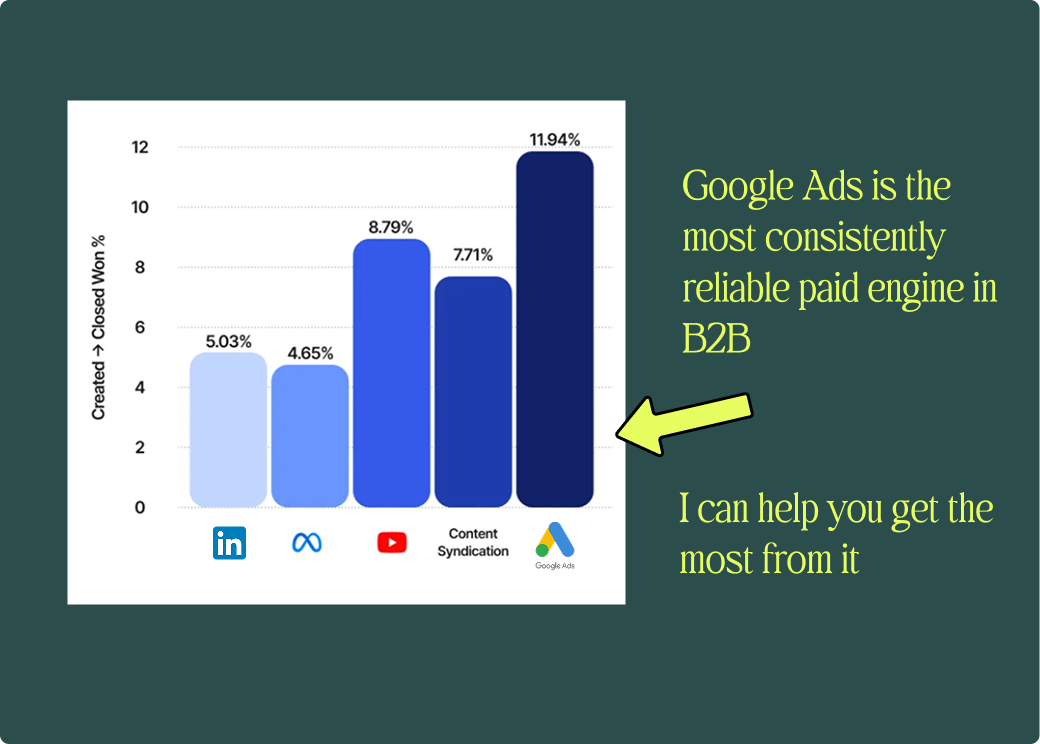
Most accounts underperform because:
• They’re run by junior marketers under agency supervision
• Broad match keywords pull in low-intent, expensive traffic
• Search term reports are full of irrelevant queries
• Landing pages aren’t built for conversion or quality score
• Reporting stops at leads, not revenue
• Founders can’t see what’s actually working
So spend goes up, traffic looks healthy, but pipeline doesn’t.
I run Google Ads with a demand-capture-first mindset, focused on revenue, pipeline influence and ROI.

Everything starts with search term quality.
The goal is simple: only show up when your ICP is actively looking to buy.
This makes optimisation faster and mistakes obvious.
Google rewards relevance.
You shouldn’t have to outspend competitors to beat them.
I’ve built and run landing pages with a web visitors to leads conversion rate of 22%.
Learn what search terms drive pipeline that converts.
This includes:
You’ll know which keywords actually make money.
Once the foundation is solid, we expand.
This works best if you:
I’ve run Google Ads from early-stage companies through to Series D scale-ups.
Exact match gives you control early on. It forces clarity on what demand actually converts, keeps spend focused on real buying intent, and makes it obvious which queries deserve budget. You can always expand later — but starting broad usually just accelerates wasted spend and noisy data.
Google’s incentives aren’t perfectly aligned with yours. Left unchecked, the platform will happily broaden targeting, loosen match types, and chase volume over efficiency. Accounts need guardrails, regular pruning, and deliberate constraints to stop budgets drifting toward low-intent traffic.
The goal isn’t to show up everywhere, it’s to dominate the searches that signal readiness to buy. Technical queries usually indicate that the person searching those terms are your ICP (and not juniors/students/random web searchers). They tend to convert better across the funnel. High impression share here means you’re as present as you can be when serious buyers are actively evaluating vendors.
Improving your landing page conversion rate will improve your ROI and your ability to scale. Even well-targeted keywords will underperform if the landing page lacks clarity, relevance, or a clear next step. Improving message match, structure, and proof is an often overlooked part of the PPC ecosystem.
Google Ads is one of the few B2B channels that can scale while staying efficient. It works across Enterprise, Mid-Market, and SMB, and tends to deliver consistent pipeline without the unpredictability of other paid channels.
Google Ads make sense for a B2B company when there is clear, existing demand and a realistic chance of capturing it efficiently.
They tend to work best when:
Buyers are actively searching for solutions
If your buyers already know the problem and are using Google to look for tools, vendors, or comparisons, Google Ads can capture that intent effectively.
You know which keywords indicate buying intent
Google Ads perform well when you target commercial, problem-aware searches — not broad, generic terms that attract researchers rather than buyers.
You can connect ads to revenue, not just leads
Google Ads make sense when performance is measured in pipeline and deal quality, not just form fills. This usually requires CRM integration and post-lead analysis.
Your positioning is clear enough to convert demand
If buyers land on your site and immediately understand who the product is for and why it’s different, Google Ads can be efficient. If positioning is unclear, ads amplify waste.
You’re prepared for rising competition and costs
In many B2B categories, Google Ads are saturated. They work when you accept that:
Google Ads make less sense when:
In short, Google Ads are strongest as a demand capture channel, not a growth silver bullet. They work best as part of a wider B2B strategy — not as the only source of pipeline.
If you’re unsure whether Google Ads make sense for your category, that’s usually a sign they need reviewing before more budget is added.
Both.
I regularly audit, fix, and improve existing Google Ads accounts, and I also build new accounts from scratch when needed.
For existing accounts, the focus is usually on:
For new accounts, the work starts with:
In both cases, the goal is the same: make Google Ads commercially useful, not just “active”.
If Google Ads aren’t the right channel for your category or stage, I’ll say that upfront — rather than rebuilding or scaling something that won’t work.
The biggest difference is how decisions are made and what the work is optimised for.
With this service, you work directly with an experienced B2B growth marketer who owns both strategy and execution — not through layers of account managers or junior operators.
Key differences include:
Pipeline-led optimisation
Agencies often optimise to platform metrics like clicks, CPC, or cost per lead. This work is optimised around pipeline quality, deal value, and revenue wherever possible.
Senior, hands-on involvement
There’s no handoff to junior teams. The person setting direction is the same person auditing keywords, building structure, and making day-to-day changes.
Focused on reducing waste, not increasing spend
Agencies are typically incentivised to manage more budget. This approach focuses on cutting wasted spend, tightening intent, and using Google Ads only where they genuinely make sense.
Integrated with the rest of your growth strategy
Google Ads are treated as one channel within a wider system — not as an isolated lever to pull harder.
Flexible and honest engagement
No long contracts, no pressure to scale spend, and no pretending Google Ads work for every business or category.
For many B2B teams, this results in lower waste, clearer insight, and better commercial outcomes than a traditional agency model.
Both — but with a strong bias toward hands-on management.
I don’t operate as a traditional consultant who delivers recommendations and steps away. I work directly in your Google Ads account to make changes, test improvements, and iterate based on results.
That typically includes:
Advice is part of the work, but it’s always tied to execution. The aim is to improve performance in the real account, not just tell you what should happen.
If you already have an internal team, I can work alongside them. If you don’t, I can fully manage Google Ads end-to-end.
The goal is to make Google Ads commercially useful, not just active.
That’s common — and in most B2B cases, Google Ads don’t fail because the channel is broken. They fail because they’re set up and measured in a way that doesn’t match how B2B buying actually works.
Google Ads usually underperform when:
This approach is different because it focuses on commercial usefulness, not activity.
That means:
In many cases, Google Ads can work — but only when they’re treated as a precision demand-capture channel, not a volume lead machine.
If Google Ads genuinely aren’t the right fit for your business or stage, I’ll say that upfront rather than repeating the same mistakes with more budget.
Stopping wasted spend in Google Ads comes down to tight intent control, ruthless exclusions, and optimising for revenue — not clicks or form fills.
In B2B, most wasted spend comes from Google matching your ads to searches that look relevant but don’t indicate buying intent.
The main ways I stop that are:
1. Aggressive search term management
The fastest way to reduce waste is by reviewing the Search Terms Report regularly and:
Google will always try to expand reach. The job is to push back hard.
2. Focus on buying-intent keywords only
Keywords are prioritised around:
Broad, ambiguous keywords are either avoided or tightly controlled.
3. Strong account structure
Separating campaigns by intent (for example brand, non-brand, competitor) gives control over:
This stops high-intent keywords being dragged down by poor ones.
4. CRM-led optimisation
Google Ads are connected to your CRM so optimisation is based on:
This prevents Google from “optimising” toward cheap but useless leads.
5. Landing page clarity and conversion control
Wasted spend isn’t just bad traffic — it’s traffic that doesn’t convert. Pages are optimised so buyers quickly understand:
Higher conversion rates mean less wasted spend for the same clicks.
6. Audience controls where appropriate
Where useful, audiences are used to:
The goal isn’t to make Google Ads bigger — it’s to make them tighter, cleaner, and commercially useful.
Most accounts don’t need more budget. They need less waste.
Yes — for Google Ads optimisation projects, there’s usually a three-month minimum commitment.
That timeframe is important because it allows enough time to:
Shorter engagements rarely provide enough signal to judge performance fairly.
The exception is short-term cover.
If you need someone to manage the account while you hire a new in-house Google Ads specialist, I can step in on a short-term basis to keep things running smoothly.
After the initial period, the engagement can continue on a flexible, month-to-month basis.
The aim isn’t to lock you in — it’s to give the work enough time to actually make a difference.
Google Ads work is typically priced as a monthly retainer, rather than a one-off project, because performance depends on ongoing optimisation and iteration.
To work with me, retainers usually start from £2,400 per month.
For micro businesses or very small accounts, I can make exceptions where the scope and needs are more limited.
Final pricing depends on:
For most B2B companies, working with a freelancer provides senior, hands-on expertise at a lower cost than hiring in-house or retaining an agency.
Before starting, pricing and scope are always agreed upfront — and if Google Ads aren’t the right investment for your stage or category, I’ll say that honestly.