
I design, run, and document high-impact growth experiments for scaling startups to unlock growth opportunities across the full-funnel.
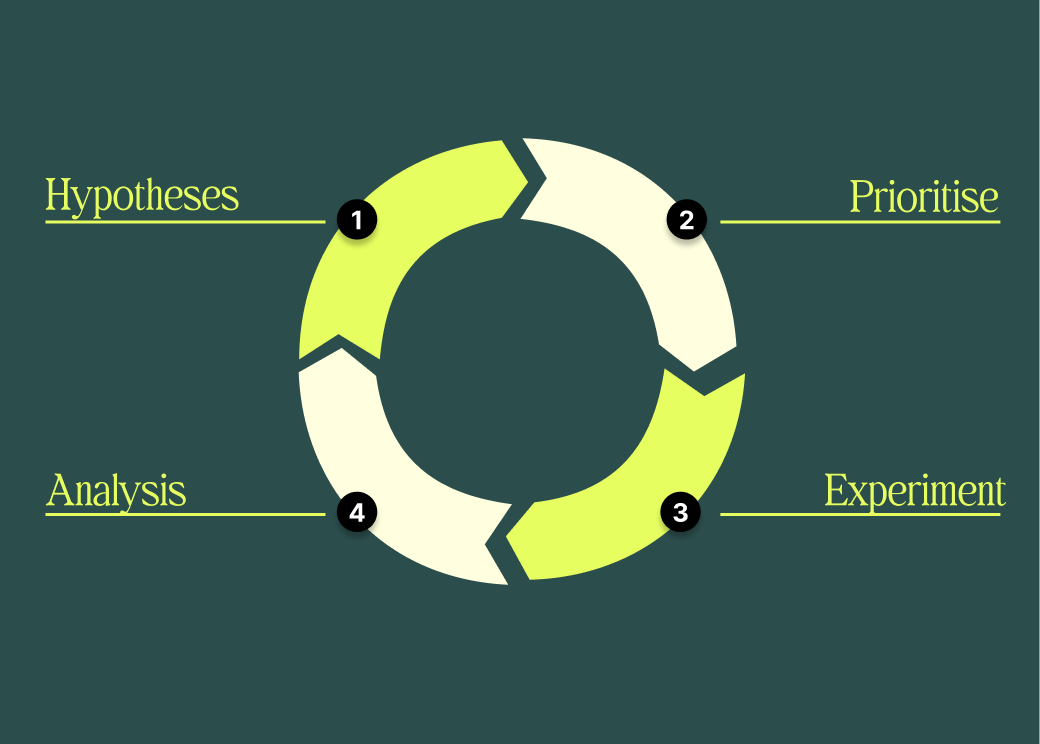
For many reasons:
• Experiments get deprioritised for urgent requests and fire-fighting
• Ideas are captured, but rarely scoped, prioritised, or shipped
• Tests are rushed or half-run with unclear success criteria
• Learnings live in people’s heads, Slack threads, or not at all
• The same ideas get revisited because nothing is properly documented
• Growth becomes a background task instead of a deliberate system
I run a structured, sprint-based growth experimentation process for B2B scaleups that compounds learning and results over time.

We start by understanding where experimentation will matter most.
This ensures we’re testing important things, not just easy ones.
Next, we create a clear, ranked backlog of experiments.
This becomes a living backlog you can keep using long after I’m gone.
I work in short, defined sprints — typically one experiment at a time.
The goal is fast, validated learnings, with high-impact outcomes.
Every experiment ends with a clear outcome. Failures are treated as progress.
All experiments are documented in a shared system.
This builds an internal growth knowledge base so learning compounds instead of resetting when people leave.
Over time:
You’re left with a repeatable experimentation engine, not dependency on one person.
This works best if you:
Economic headwinds and increased market competition mean that marketing teams today are expected to do more with less. Growth experiments via a freelancer can help you unlock more opportunities for growth, without sidetracking your team.
Growth experiments in B2B are small, structured tests designed to answer specific growth questions quickly, without committing large budgets or long timelines.
Instead of guessing which channel, message, or tactic will work, growth experiments are used to:
In a B2B context, experiments can sit anywhere in the funnel, including:
Each experiment starts with a clear hypothesis, a defined success metric, and a short timeframe. If it works, it’s scaled. If it doesn’t, the learning is captured and the business moves on — without sunk-cost attachment.
For B2B companies, growth experiments are especially valuable because:
Growth experiments create a repeatable way to learn and make decisions, rather than relying on opinions, playbooks, or copying what worked for someone else.
In short, growth experiments help B2B companies move forward with evidence instead of assumptions.
Yes. Growth experiments can be run across the entire B2B funnel, not just at the top.
That includes experiments focused on:
The focus isn’t on running lots of disconnected tests. It’s about identifying where the biggest constraint is right now and experimenting there first.
For some teams, that’s getting more of the right leads in. For others, it’s improving conversion, shortening sales cycles, or increasing win rates.
Experiments are prioritised based on:
Running experiments across the full funnel ensures learning translates into real commercial progress, not just surface-level optimisation.
Usually one core experiment at a time.
That’s deliberate.
In B2B, running too many experiments in parallel often:
The goal isn’t volume of experiments — it’s quality of learning.
A single experiment is typically supported by:
In some cases, small supporting tests (for example creative variations or messaging angles) may run alongside a main experiment, but there’s always one clear learning objective at a time.
This approach ensures:
For most B2B teams, progress comes faster by running fewer, better experiments — not by trying to test everything at once.
Experiments are prioritised based on impact, speed, and effort — with the goal of learning as much as possible, as quickly as possible, with the least risk.
The first experiments are usually the ones that:
In practice, this means starting with experiments that can:
Rather than running “interesting” tests, the focus is on experiments that answer the most important questions the business is facing right now.
As learnings compound, experiments become more ambitious — but only once the foundations are clear.
The aim is not to run as many experiments as possible, but to run the right experiments at the right time, so effort turns into insight and progress, not noise.
Yes — there’s a three-month minimum commitment for growth experimentation work.
That timeframe is important because it allows enough time to:
Growth experimentation isn’t about running one-off tests. It’s about building momentum and learning over multiple cycles.
After the initial three months, the engagement can continue on a flexible, month-to-month basis.
The aim isn’t to lock you in — it’s to give experimentation a fair chance to create real value.