
Good marketing is mostly about doing the right things at the right time.
The problem is, most businesses don’t.
They try to scale before product–market fit. They throw money at channels when they should still be talking to customers. They optimise conversion rates before they’ve got a message worth converting.
This framework is how I think about sequencing marketing around product–market fit. It’s not a strict playbook, more of an operating principle. Marketing is messy. You’ll rarely live this out exactly as written. In all likelihood, you’ll be jumping from one spinning plate to another, balancing competing priorities and stakeholder expectations.
But when things feel chaotic, coming back to this framework should help you focus on what matters most, for where you are right now.
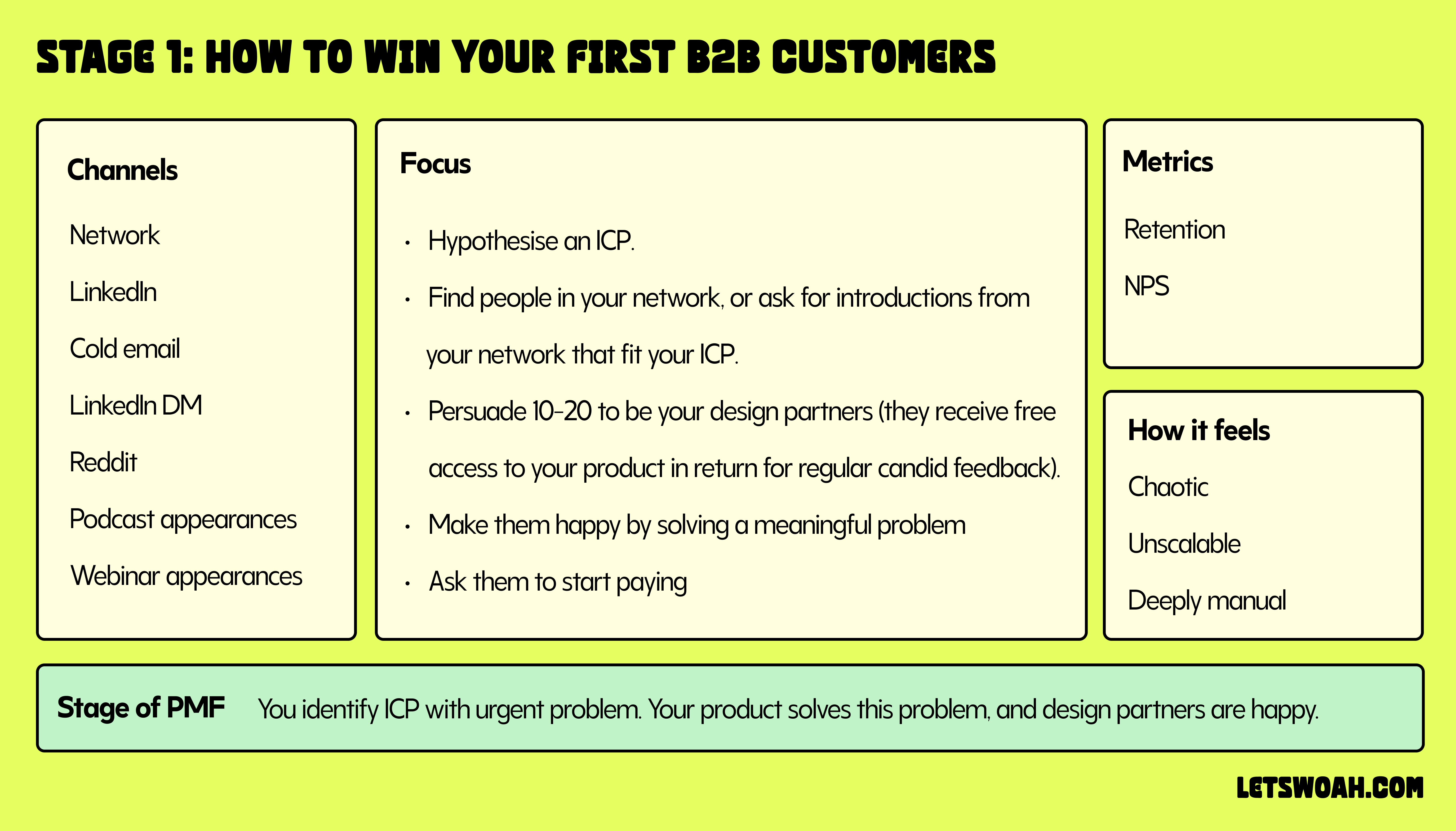
At this stage of the business, you need to validate your idea, build an effective solution to an urgent problem for your ICP, and get a few paying clients in the door. Luckily, you can do all of this with one strategy: design partners.
Design partners are organisations that aren’t paying for your solution but are willing to test it and regularly provide feedback.
You’ll want to find design partners that you theoretically think fit your ICP. Build alongside these design partners for free to create something they would want to use. Once it’s built, you can then try to progress them to paid contracts.
This works well because (a) you can get important feedback on your product, and (b) you’re creating a funnel for your first customers by providing them value for free upfront, building a product that solves an urgent problem for them, helping them solve the problem, and then converting them to paying customers.
And, to state the obvious here, if your product works well, then you’ll be able to convert them to paying customers. If it doesn’t, then you won’t get any paying customers, and you’ll need to iterate across the 4Ps (persona, problem, promise, product) and try again.
So, we want 3–5 design partners minimum.
Friends, family, and people you’ve worked alongside are the best starting point. If you don’t have anyone in your immediate network in your ICP, then ask for intros from your network to anyone they know. This is the most effective way for startups to get started.
If you follow this step and you’re still struggling, then here are some alternative ways to find design partners.
Maybe my second-favourite tactic. It’s a numbers game, but a really effective way to find design partners can be DM’ing your ICP on LinkedIn, or cold emailing them. Connect with them and ask for feedback on an idea you have. People love to be respected for their opinions, so framing it as if they’re the only person in the world with the level of insight you need to move forward can help. If you can get them on a 15-minute call, collect all the feedback you can and, at the end of the call, ask if they’d consider being a design partner. At the very least you’ll have early product feedback; best case, you’ll have a design partner.
Again, it’s manual, but following this process for a few weeks will land you your design partners.
I won’t go on and on here about all the benefits of posting on LinkedIn (I’ll let all the LinkedIn gurus do that), but rest assured, if you can get over the initial ‘ick’ factor and start, you’ll attract your ideal clients. Connect with members of your ICP; talk about the problem you solve constantly, in as many different ways as possible. Search keywords related to your problem and comment on posts with them in. Over time, with the right point of view, you’ll be known as the person who’s solving X problem. This will attract people with that problem, so you have warm prospects engaging with your posts. You can then ask for design partners publicly on LinkedIn, and if you’ve built a niche group of followers with the problem you’ll solve, you’ll have found your design partners.
Your ICP is on Reddit, somewhere. Find the subreddits they live in and join in. Comment, be helpful, post, ask questions. It is horrendously manual and certainly not as glamorous as you thought being an entrepreneur would be, but you can absolutely find design partners and customers from Reddit. And at the very least, you’ll learn a lot more about your ICP because subreddits are where your target buyers will talk honestly about their problems.
And finally, as you begin to learn about your ICP and the problems they have, you’ll hopefully start developing an interesting point of view. Reach out to companies and people running webinars and podcasts to audiences in your ICP. Practise your spiel and see if your message resonates. Hopefully, you can communicate a really clear point of view that resonates deeply with members of the audience, so a few hours later you can have your inbox full of listeners ready to learn more.
At this stage, a founder’s primary job is to find a problem worth solving for three to five customers. And by problem we mean an issue that is urgent and important for them, where solving it would be immensely valuable for their business. With that in sight, it’s time to build a product that solves the problem and delivers high satisfaction for those customers. You may need to iterate across the 4Ps (persona, problem, promise, product) a few times to land on the right combination. — First Round PMF
What this stage feels like: Chaotic, unscalable, deeply manual (and yes, this is normal)
How to move to the next stage: To move to the next stage, you’ll want to see signs of potential PMF. That will look like happy customers (who aren’t just being nice) and design partners converting into paying customers with little pushback.
Metrics: Retention, NPS
What if you get stuck at this stage?
Revisit the 4Ps (persona, problem, promise, product) until you land on the right combination. Don’t skip this step unless you want a stressful, stagnant business!
Ok, so you’ve got a couple of happy, paying customers. Great. Let’s get a few more.
If you’ve got a couple of happy customers but still want stronger signals of product–market fit (which is wise), then repeat the process in Stage 1. As an early-stage funnel, it’s a great way of winning clients, and it makes sense to go slow now so you can go fast later. Also, at this stage of the business, you’ll never have the flexibility to get so much feedback and change the product direction so quickly. As the organisation matures, your product will get clunkier, and you’ll be building systems and processes around it. So if there’s any doubt, stay in the design partner cycle until you’re ready to venture out, with early product–market fit confidence.
This stage is about:
I’ll break each of these steps down.
In the previous stage, we worked closely with our customers to learn more about them. Now it’s time to learn more about the wider market. Where do they hang out? Where do they learn? Who do they learn from? Who influences them? And then, for your solution specifically, what needs to happen for them to come in-market? What triggers them?
These are the fundamentals you need to know about your market before you try to promote your business. Remember, the game of marketing is not to do as many activities as possible to promote your business; it’s constantly deciding what the most effective marketing activity you should be doing is at this precise moment. And to do that, we need to know more about the wider market.
To learn about the wider market, you can continue to speak to your ICP like you did in Stage 1. But instead of focusing heavily on product-related questions, you may want to add some questions like I listed above. You can also do this with a YouGov survey. It’s the fastest way to reach your ICP and surprisingly reasonably priced. The downside is the answers can lack a bit of context, but it’s a really effective way to reach 100 people in your ICP fast. A bit of basic market research can go a long way.
A framework that’s emerged in recent years is Category Entry Points (CEPs). CEPs are the situational triggers that bring your ICP in-market for your solution, and they’re great for getting you thinking about your solution’s use case. I suggest you list all the possible triggers for your business.
An example of a CEP from B2C is the famous Snickers “You’re not you when you’re hungry” ad campaign. The aim of this ad was to associate solving the feeling of being ‘hangry’ with a Snickers bar.

I used CEPs to great effect when I led the marketing team at a B2B mental health startup called MYNDUP. We realised that a common CEP for our ICP was when HR teams became frustrated with the mental health provisions their Employee Assistance Programmes (EAPs) offered their employees. EAPs do a great job for the cost, but they’re very limited. For HR teams who want to do more for their employees, MYNDUP is a great alternative. And so we ran a few ad variants testing this CEP as a LinkedIn ad. The ad below was our most successful. It was highly shared by HR teams across ‘dark social’ channels like Slack, Microsoft Teams, WhatsApp, and online communities. Through asking leads ‘How did you hear about us?’ on our demo form and on sales calls, we learnt that this single ad creative generated close to 30% of the leads we generated in 2023.

All that knowledge you’ve just acquired learning about your market is about to become very useful. It’s time to position.
Positioning for software products is hard.
And necessary. It forces alignment. By putting a stake in the ground and saying ‘this is our company and this is who we serve’, it aligns you with your co-founders and gives you clarity on who you solve problems for and who to build the product for.
For an early-stage software/AI company, you’ll want to decide:
So you can then land on a positioning statement, like this:
Xeym is AI project management software that helps marketers at marketing agencies spend less time communicating with clients.
The more specific your positioning is, the more your message will resonate with your target audience, and the more likely AI search tools will recommend you to your target audience. The more specific you are, the greater confidence the AI will have.
Sometimes, we position in the wrong direction. Maybe we’ve overestimated our impact with certain types of businesses, or the feedback we’ve received has been slightly biased. As an early-stage business, you’ll constantly be in a cycle of feedback, so the urge to iterate on your positioning will be strong.
The danger of iterating too much on your positioning is that, fast-forward a year, you have lots of different clients with wildly different needs, and your product requirements will give you a headache trying to figure out how you can possibly keep everyone happy. So do so with caution. Ideally, the first position you take fits the feedback you’ve received and fits the market’s demand so you can build the product in a focused direction.
A good way to know if your positioning is resonating is the concept of message–market fit.
Message–market fit is when the way you talk about your product clicks perfectly with the people you’re trying to reach.
Or, in simpler terms:
Product–market fit means people want what you’re selling.
Message–market fit means people understand why they should want it.
You’ll know if you’ve got message–market fit if your prospective customers just ‘get it’. Maybe they ‘get it’ after your elevator pitch, or even better, they see your website, jump on a call with you, and already know they want to buy.
By positioning the business and nailing how you articulate what you do, you’ll have the foundations built. Next, you’ll want to focus on channels where you can reach your buyers with this messaging.
You’ve probably already got a website. If you haven’t, now’s the time. You’ll want to update the messaging on your website with the outcomes from the positioning.
At this stage, because you’ll still want to validate your positioning and messaging, a 3–5 page website will suffice.
Establish a presence where your buyers go to review vendors in your space. That might be G2, Capterra, Trustpilot—it might be an industry-specific review site, or even Google Business Profile reviews. Make a conscious choice to understand and choose. The question is: if I have to pick one review site to collect customer reviews on, which review site will my ICP care about the most? Pick one, and go get your first customer reviews. This is a long-term play, so you’ll want to think about building processes around collecting reviews.
Keeping your customers happy is essential, no matter what size of business you are. Happy customers are your biggest drivers for word of mouth. And word of mouth is the single most influential touchpoint in all of B2B marketing.
Start with any existing customers—make them as happy as possible. Send them gifts on their birthday, respond quickly to messages, ask questions about their personal lives, be interested, be warm, and show your gratitude always. Your first customers have taken a risk on you. Tell them often how thankful you are and how much you value their input. If you can build authentic relationships with early customers, you can be honest and ask if they know anyone your solution could help. If some are financially incentivised, you can offer financial rewards for referrals which turn into customers. Most, however, won’t even ask. They’ll be happy to do it.
These will be your source of referrals as you get started.
Find partners that work with your target ICP. These could be consultants, agencies, communities. Reach out and see how you might be able to work together. The holy grail here is consultants who, while being vendor-agnostic, would be open to a revenue-share model if they point prospects in your direction. One or two partners like this can have huge ROI upside.
You could also work with partners on a pay-per-lead basis. It could also be co-marketing with them where you’re both benefiting from each other’s audiences (think webinars, podcasts, blogs, social posts, etc.).
Partnerships can be a bit of a numbers game. You might try to reach out to a few and get nowhere. Or someone agrees to a pay-per-lead agreement but then proceeds to send you nothing. Or worse—poor leads.
You’ll probably think “partnerships won’t work for us”. They might not, but in my experience, you have to kiss a lot of frogs in partnerships to find your prince. It’s worth persevering with.
What this stage feels like: Still chaotic. Less manual. Slow. Sprouts of possibility.
How to move to the next stage: Message–market fit. Messaging is resonating. You’re starting to win business from strangers. You’ve spent a lot of time with your ICP; it’s clear they have an urgent problem your solution addresses. You get your first inbound leads.
What if you get stuck at this stage?
Get closer to your ICP. Test different messages. If it still isn’t working, then review the 4Ps (persona, problem, promise, product) and start again. If you move to the next stage without a validated ICP and message–market fit, then it’ll be costly for the business. You’ll hire people you’ll probably have to make redundant in the future; you’ll spend money (most likely investors’ money) targeting an ICP that doesn’t urgently need your solution (which is very costly); and you’ll put pressure and stress on yourself. Sometimes in life we have to go back to go forwards. This is one of those times.
Metrics: Message–market fit, one or two partners, customer referrals coming inbound
.png)
This third stage is where most businesses get to and stay. The previous stages are quick—they’re about getting your first customers and setting up the foundations of your marketing engine. Here, you’ll be focused on marketing to just 5% of your market, and you can have a great business by never leaving this stage.
Research by the Ehrenberg–Bass Institute for Marketing Science suggests that 5% of potential buyers are in-market at any given moment, and 95% of your potential buyers aren’t. It is far easier to convince an in-market buyer to buy your solution than an out-of-market buyer. So it makes sense to go after the 5%.
Soooooo, how can you reach the 5% of in-market buyers?
Here’s how you can do this.
This stage is about reaching in-market buyers where they’re looking for solutions. The most common place this will happen is search engines like Google. And so, because of this, we’ll be sending all of this traffic to our website.
Now is the time to be laser-focused on your visitor → lead conversion rate. If your website isn’t optimised, you’ll be pouring money down the drain. Let’s not do that.
First, set up the ability to measure how many website visitors you get, what pages they go to, and how many convert into qualified leads. There are many things that are difficult to measure in marketing, but this is not one of them.
Next, outline your customer pathways and optimise them all.
These are just some of the pathways you can think about improving. Throughout this stage, you’ll want to be running growth experiments to see how you can improve your conversion rate.
We covered review sites and partners in the previous stage. Here, we’ll focus on the new, more resource-intensive activities you’ll want to be doing at this stage to reach in-market buyers.
SEO is a long-term play, but nearly always worth it. You’ll have a hard time meeting any founders who invested in SEO three years ago and regret it. The issue is that you are unlikely to get immediate results. In your head you should have the expectation to not repay the resource you put into this for 12 months. Gulp.
But SEO has offered huge ROI rewards for the leaders who have had the conviction to suffer in the short term. With AI search rapidly changing the landscape here, there is now more uncertainty and more risk. But AI search also offers opportunity. Which companies are currently benefitting from AI search adoption? The ones who have excelled at SEO. Large Language Models are trained on web pages, and optimising for AI visibility is very similar to traditional SEO. So while there’s more uncertainty as to whether SEO investment is the right choice, evidence points to it still being a wise decision.
Start with long-tail, bottom-of-funnel keywords. These will have low competition (which makes it easier to rank high) and have high buying intent. Match keywords that fit the language your target buyers will use, so even if there are only 20 searches for the keyword you want to rank for, you know that most will be from your target audience.
Because people search differently with AI search tools, you can also generate leads by creating highly specific content on your ICP’s use cases. What’s working right now is to create use case pages on your website. Again, mirror the language your buyers use (and might type into ChatGPT), and build out specific pages about how your product solves for them.
An example I like is by my friends at Primer. I found out about Primer via ChatGPT, which pulled one of their many brilliant use case pages. They break down their product into the use cases it solves for their ICP. Each page clearly communicates to LLMs that they can solve the problems that their ICP will be searching to solve with AI search.
Paid search is the fast but expensive option to increase your visibility with in-market buyers. Where SEO takes 12 months to see a return, getting ads up and running on Google Ads can take a few hours.
The downside is that it’s competitive and expensive. I’d suggest doing both Google Ads and SEO. If you just did Google Ads, you’d be a slave to the bidding auction. If you do both, you can get immediate rewards and improve your CAC over the long term, as your SEO performance reduces your reliance on Google Ads.
I’d suggest finding an experienced freelance B2B growth marketer to get you set up on Google search ads. You’ll want to start with exact-match, high-intent, low-volume keywords. Every day you’ll want your marketer to look at the search terms report and exclude any non-relevant keywords (Google loves to try to get you to spend money on irrelevant search terms). Not doing so will cost you money.
Paid placements are another fast, expensive option to increase your visibility with in-market buyers.
Use ChatGPT to come up with different high buying-intent search terms and explore on Google the pages that rank organically for these search terms. Many of the pages that rank—and that aren’t from a competitor—will offer options to pay to be on there. The best options look like vendor-agnostic comparison sites offering lists of ‘best [insert category here]’. They’ll likely offer PPC options to appear.
Not only will these sources send you traffic that will almost certainly convert into leads, but they’ll also help you improve your visibility in AI search when a prospect is searching for ‘tools that do X’ or the ‘best X tools’.
If you do decide to do this, add UTM tags to each specific paid placement link so you have some way of attributing the leads.
Finally, we’ve paid a lot to get prospects to your website. If they click away from your website, we don’t want them to disappear forever. On average, visitors need 54 touchpoints before they’ll convert as a lead. And 81 touchpoints before closing, so you’ll want to keep them in your ecosystem. Here’s how you can do that:
Get your freelance growth marketer to create a remarketing campaign on LinkedIn. This means that visitors to your website will be shown your ads on LinkedIn after their visit. A good growth marketer will create three different audiences—30 days, 90 days, and 180 days. You’ll put more money behind the 30-day audience and less in the 180-day audience, as recent website visitors are more likely to be in-market than someone who visited your site 180 days ago. The aim here is to reduce your web visitors’ memory decay of your brand. Ads should be bold, stand out, and be memorable. If you can maintain a presence in your buyers’ memory, then when they move into a buying situation, they’re more likely to think of and consider you.
A great, no-cost option is an email newsletter. Write about the problem you solve every two weeks and send it out to your subscribers.
I’ve worked with many good businesses that have one main GTM tactic—webinars. I’m always surprised how well they can work, but they do. Titles with ‘How to…’ work best. Focus a webinar every month on the problem you solve, and get subject-matter experts on it. Work with your partners; get your customers on there. They also work very well for repurposing content (a webinar may create 50% of your next three email newsletters and a few LinkedIn posts, too).
If you’re doing cold email at this point, you can blast out some invites to anyone you think would have a legitimate interest in it. Your email newsletter too.
This is the stage where you’ll find your low-hanging fruit. This is where growth should really ramp, and it will feel great.
What this stage feels like: This is where your mindset starts to shift. Growth feels easier now than it ever has.
How to move to the next stage: If you’re showing signs of strong product–market fit (which most businesses don’t get to) and you feel like you’ve hit a ceiling, then you’re ready to go after the 95% of your market that aren’t in-market.
What if you get stuck at this stage?
You’ll likely be struggling with the economics of winning new clients vs the cost of getting them (in other words, your CAC will be too high). It might be that you can generate leads cheaply, but your win rate is low—or vice versa. Typical levers here are fine-tuning your product, your offer, and your channels (sometimes, in a new category, the low-hanging fruit channels we’ve outlined here don’t work well, as demand isn’t high enough). Make sure you’re trying as hard as you can to understand why you lose deals. Prospects will want to palm you off and give generic reasons why they didn’t go with you, but you want the actual reason. That means calling them often, emailing often, sending surveys—doing everything you can. The insights here can unlock your growth path moving forwards. For instance, it could be that you couldn’t integrate with their tech stack. Or maybe they couldn’t complete the deal in time and auto-renewed with their current provider. These insights inform how you can creep up your win rate by addressing these issues for future buyers.
Things you can’t do much about but are helpful to consider are managing stakeholder expectations (investors in particular) and navigating market headwinds. Difficult economic conditions reduce organisations’ appetite for risk. Taking a chance on a startup is less likely in these conditions, and one to be aware of.
It might be that you're struggling to get the price point that you want. This is often a signal that customers see your product as a nice-to-have versus a must-have. You often hear "we don't have the budget' or 'it's not the right time' in conversations
- First Round, PMF
But getting stuck at this stage is also OK. Many good, profitable businesses do. You can build a good business with good economics over the long term by staying here. In this day and age, the urgency to “scale” before building something valuable and sustainable is a disease. Only move to the next stage when you have signs of strong product–market fit.
Moving to the next stages will increase your CAC but widen the market opportunity. This current stage can be a good place for bootstrapped businesses to live and stay until they’re mature enough to take on the risks of going after the 95% of your TAM that aren’t in-market. For VC-backed startups, your investors won’t give you the choice—they’ll be intent on you moving to the next stage. Investors want returns, and they want them as quickly as possible.
Metrics: CAC, estimated LTV, AOV (12-month), win rate, website visitor → lead conversion rate, burn rate
.png)
You’ve reached the fourth stage. Great job—many startups won’t make it this far. Or they’ll try these channels but really, they’ll be stuck in previous stages with low levels of PMF. It’s costly to skip to this stage without strong product–market fit—not only will it be expensive, but you’ll waste energy on the wrong channels which will cost you results.
In the previous stage, we targeted in-market buyers. Five per cent of your market will be in-market for a solution, and 95% won’t. The 95% are your future buyers, and at this stage, we’re finally going to go after them.
Warning! It’s difficult. As I’ve said, this is the stage where most startups either don’t make it this far or get stuck here. It can be costly to target future buyers, so you’ll either need to be well funded or mature enough as an organisation to manage the increase in your CAC as you climb this mountain.
I’m painting this to be a difficult picture. Because it is. But the market opportunity can be massive. It’s imperative that you only go after this stage when your levels of PMF are high. In First Round’s Product–Market Fit Framework, you’ll be at Level 3, or showing signs of strong product–market fit. You know your customers really well, you know the message you have resonates, and your solution is bringing tons of value to them.
The analogy here is that it’ll start to feel like you’re pushing a boulder downhill. Before this stage, it would have felt like you were pushing a boulder uphill.
So the best time to start this stage is when the floodgates appear to be opening.
Hire a team of young, smart and highly motivated SDRs to reach out to the 95%. Oddly enough, cold calling can still work in 2026. This team will be there to prospect your ICP—calling, emailing, DMs. This is when you’ll really know if you have message–market fit.
The great thing about a sales academy is they can compete against each other, and top performers can be rewarded with progress up the ladder. This can feed your CSM and AE hiring.
How many ads do you remember from LinkedIn? I’m going to guess not many. LinkedIn has the best B2B data, so the granularity of targeting is better than any other paid social channel. It’s also where B2B buyers are active and ‘in work mode’. Tick and tick. The challenge with LinkedIn ads is they can be expensive, and it’s difficult to stand out. If you think about it, LinkedIn is a place where everyone is trying to get in front of their ICP and show them how great they are. So the key to LinkedIn ads is to be memorable. Stand out from a sea of sameness. Do things nobody else is doing. Stop thumbs from scrolling past your ad. Capture attention. Communicate a simple, memorable message. And repeat.
My mantra is (and ex-colleagues can back me up here because everyone gets sick of hearing it): don’t make it look like an ad. Most of your ICP will spend hours every day swiping past ads to get to content they want to consume. We’re insanely good at filtering them out. It happens without conscious thought, and it’s an advertiser’s nemesis. The solution is always: don’t make it look like an ad.
LinkedIn ads are difficult to attribute. It’s unlikely somebody will click on your ad and book a demo there and then. It does happen, but if this is your primary attribution method (known as last touch), then LinkedIn ads will always look like a poor investment. Whereas Google Ads would look like a great investment, because you’re advertising to in-market buyers when they’re researching vendors. It’s comparing apples with oranges.
What we can do is ask demo form fillers ‘How did you hear about us?’ and track LinkedIn mentions. We can use tools like Fibbler to see how many touchpoints an account had with LinkedIn ads prior to deal creation. We can also use engagement metrics to get a sense of how effective the ad is for stopping the user from scrolling, and how long they dwell on the ad. The honest answer is all methods to attribute LinkedIn ads are limited but are better than nothing.
There’s a measurement bias that exists in B2B marketing that pulls us from spending money on brand campaigns and pushes us into spending more and more on Google Ads.
I worked in a scaling SaaS business tasked to make LinkedIn ads work for them. Before I started, I asked the Chief Revenue Officer where they were on the PMF framework. He said Level 2. I ignored the thoughts in the back of my mind telling me it wouldn’t work because there wasn’t strong enough PMF, and needless to say, I took the opportunity and LinkedIn ads weren’t a great fit. We did have good success with a LinkedIn gift card campaign, which generated £70k of new business in three months, but otherwise we found them difficult to scale. Always align cold LinkedIn ad campaigns with your level of PMF.
One success story is from my time leading the marketing team at MYNDUP.
Because MYNDUP’s mental health offering could generate an enormous emotional response, we found LinkedIn ads to be a very successful channel.
This is one of our most popular ads:
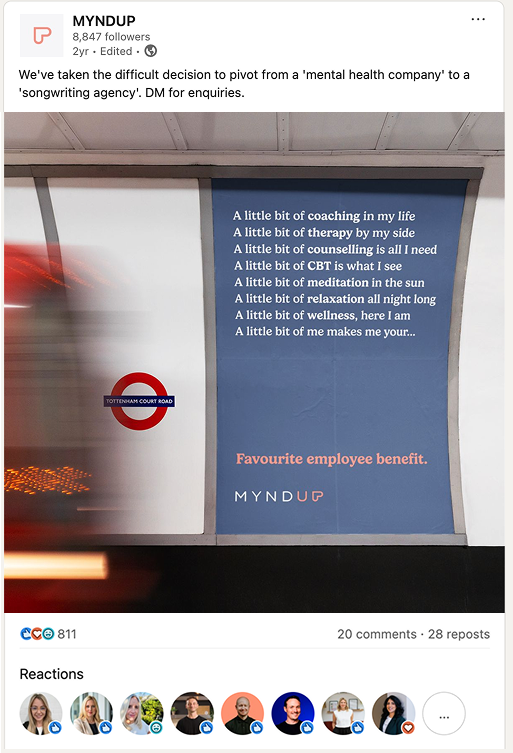
This ad was responsible for sourcing demo calls from many enterprise UK brands (some of which went on to become clients). Prospects talked glowingly about the ad at the start of the sales calls, which I always found funny. Because it’s so wildly different from other LinkedIn ads you’ll see, it stood out and resonated. After all, buyers must notice an ad to produce a response.
In my experience, LinkedIn ads work best for products that can resonate emotionally. That might mean genuine excitement at what the product can do. Maybe it’s innovative and radically different to what’s available in the market.
They don’t often work well in commoditised markets—where your unique value is difficult to communicate and really needs to be shown on sales calls; where there’s a market of 100 players and standing out can be difficult. Unless you can really lean into standing out with brand and creative, other channels will work better for you.
Many early-stage B2B startups can waste huge sums of money on events. It feels like something ‘we should try’, but events are expensive and feel effective without really being so. Well, at least not until you’re mature enough to make them work for you. Most attendees to events don’t have active buying projects on. They’re not in-market, so the chance of meeting someone who will turn into a client within a reasonable payback period is unlikely. Therefore, events are an investment in your future buyers.
I attended a Marketing & Sales event at the ExCeL in London back in 2017. I don’t remember much about the event, but I do remember having a chat with Cognism at their stand. I had a chat with one of their sales team and, while I couldn’t tell you a thing about their product a week later, I did remember the feeling the chat gave me and their company name. The salesperson was warm, personable, and an antidote to all the small talk I did that day. So when a year later I was looking for B2B prospecting data and I searched on Google and I came across them, I immediately booked a demo. I went on to become a client, and whilst their CRM probably says I was sourced via ‘Google’, I evaluated Cognism because of the chat I had at an event. The lesson here? Understand that events are for future buyers and do something to be remembered.
Events come in many forms, but the strategy is more or less the same. Start events when you’re ready to be an ever-present brand at all the major events for your ICP all year and… start events when you can afford to own the room at every event. That means being the best vendor at every event: the best swag, the best activation, the best stand, the best talk, the best talking slot. All of it. It requires significant investment upfront, with a long payback period, making it a long-term bet—but worth it if you have strong product–market fit.
By this point, you know your ICP well. You know who the influencers are in your space—the ones who are on stage, the ones who are active on LinkedIn, the ones who post often in communities. Here’s the thing: the loud minority shapes the silent majority. You want those influencers on side from as early as possible. You want to be mates with them—advocates for you. And to do that, you’ll need to schmooze. My favourite tactic here is to send them a thoughtful gift in the post. Not trying to sell your product. Just to wow them; to make their day. In return, these influencers often share their experiences of you and your product on LinkedIn and in communities. And word of mouth is the most effective channel in B2B marketing.
You’ve been running ads on high-intent search terms. Now you may want to run ads for anyone searching your brand. If your brand appears as #1 in the SERP when someone is searching your brand, then I don’t see the need to pay for an ad above it. But, if you’re not number 1, or your competitors are running ads on your brand search term, then run ads with a Target Impression Share bidding strategy.
Why? You’ll be spending large sums of money to build memories of your brand in your buyers’ minds. You don’t want your buyers to finally become in-market, think of your brand, and then search for your brand only to not find you—or worse, find a competitor.
Now’s the time to communicate your point of view to the world. The best points of view which are memorable and take hold in your buyers’ brains are contrarian ideas at the heart of the problem you solve.
Research by the LinkedIn B2B Institute shows that the most profitable ideas are contrarian and right.
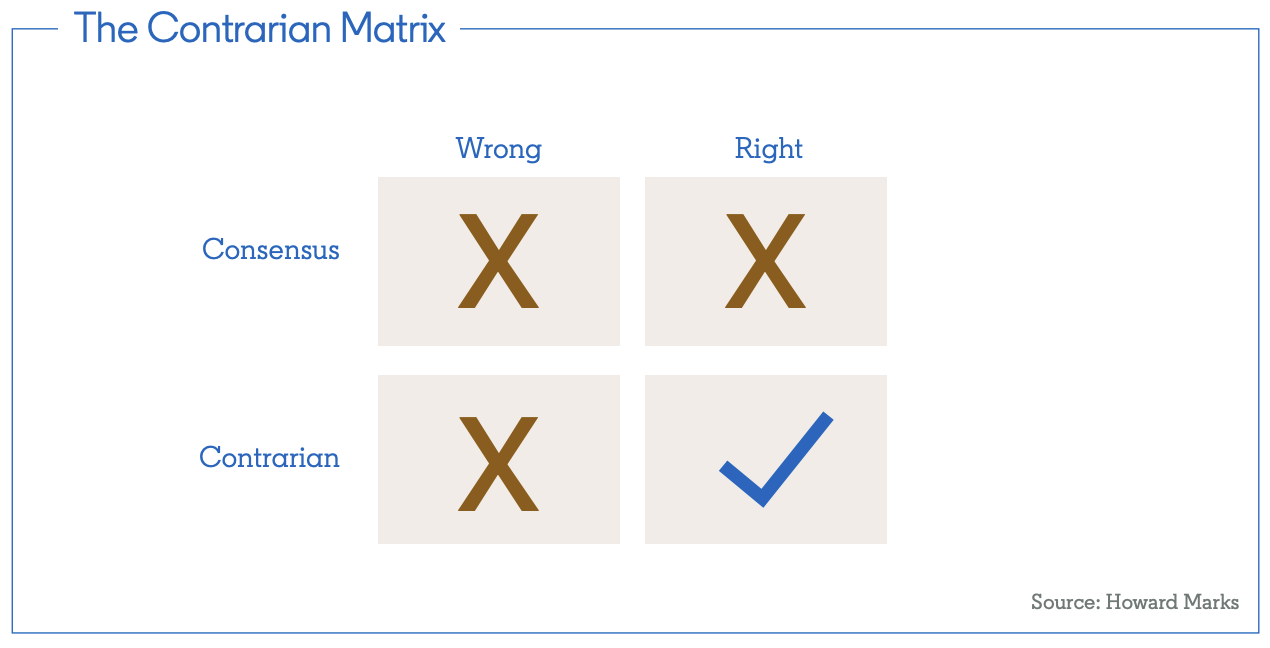
Marketers often assume that making the right decisions will guarantee success. But if all of your competitors make the same exact decision, then you wind up with no competitive advantage and, at that point, you might as well be wrong.
The lesson is simple: you don't just want to be right. You want to be the only one who's right so that you alone capture all the upside of the decision. - LinkedIn B2B Institute
For the B2B marketers reading this, most of you will know Chris Walker. Why did he become so popular for his views six years ago? Because they were contrarian and right. He challenged the status quo at a time when everyone was blindly optimising for lead volume, not revenue. He called out vanity metrics, forced marketers to think in terms of buying journeys instead of funnels, and gave people language for problems they already felt but couldn’t quite articulate. In other words, his message spoke directly to the frustrations of modern B2B marketers, and it spread because it made sense. I think this is useful framing when thinking about the point of view your content wants to return to.
Sometimes content can just be memorable, without a striking point of view. I produced a content series for a scaling SaaS company in 2025 where, instead of having a contrarian point of view, I focused on edutainment (entertaining and educational content). The series - Hiring Red Flags & Green Flags, asked recruiters to tell us their red flags and green flags when recruiting. Our presenter was full of personality, and the content resonated with our ICP. It was different, it was fun, and it talked about a subject that wasn’t usually talked about. It even got a write-up here as an example of how to build a brand moat.
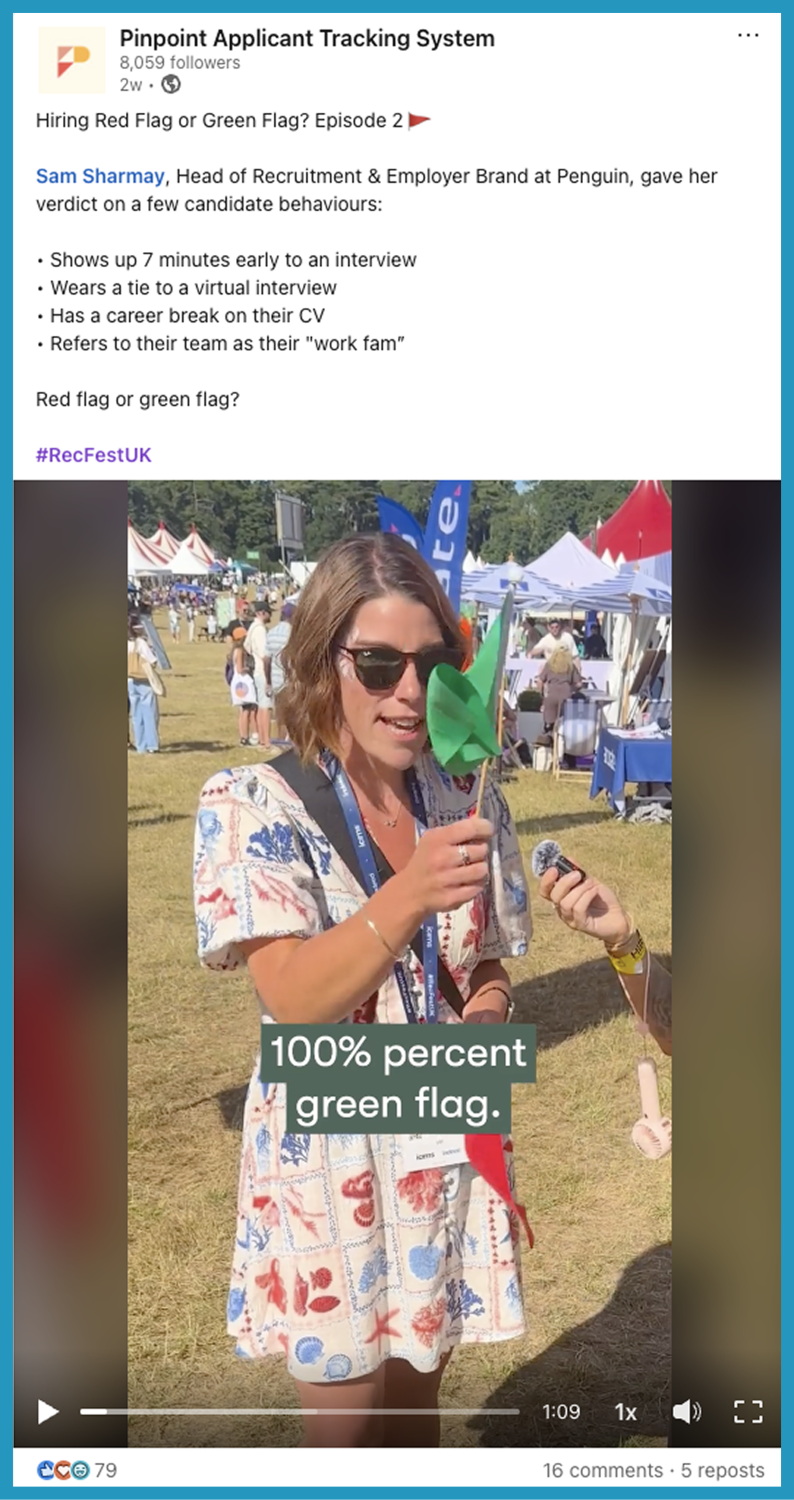
There is no rulebook with a branded content series. Just make it memorable.
What this stage feels like: Challenging & creative.
How to move to the next stage: You’ll have strong product–market fit. Your growth will keep growing YoY. You’ll be well funded, or a profitable bootstrapped business with plenty of market demand. Maybe you’ve been focused on SMB and you’re ready to move upmarket to mid-market and enterprise organisations. Maybe you want to expand territories. You’ve seen a good response from the channels above and want to keep reaching more future buyers as you diversify your product and open up new markets.
What if you get stuck at this stage? Many businesses will get stuck here. Often, it’s because they’ve over-indexed on short-term performance goals and not enough on brand. This is not a short-term stage to generate pipeline quickly. This is the opposite. It requires a long-term strategy and alignment with leaders, boards, and employees that this is the bet we’re making. The expectation is not for 50 new leads overnight. It will take time.
Your levers here are looking at leading indicators like LinkedIn ad engagement rate and average dwell time, outbound activity, number of meetings sat, monitoring brand search, brand mentions, word of mouth referrals, website views, etc. You’ll want to keep optimising for these and forget about your lagging indicators.
You can also get stuck here because of a lack of product–market fit, a lack of message–market fit, and market headwinds.
Metrics: CAC payback period, market penetration, CAC:LTV, Rule of 40
.png)
If Stage 4 was about building future demand at scale, Stage 5 is about widening who you can credibly sell to—new segments, new territories, bigger accounts—while keeping growth rate in lockstep with product–market fit.
This is the point where you stop asking “how do we get more leads?” and start asking “where do we already deserve to win, and how do we widen that?”
At this point, you should have strong signals of PMF, clear message–market fit, and repeatable ways to create and capture demand. Now we’ll expand the addressable market and the average deal size, and we’ll optimise and eke out all the opportunities we can.
Your GTM motion is in full flow. You’re a well-oiled machine, and now you’ll have the maturity to go after—and be successful winning—target accounts.
Target accounts aren’t just a list of 50 companies you want to work with; they’re target accounts because they’re similar to existing customers and represent the strongest-fit companies on the market for your solution.
You’ll likely want to tier your accounts. Tier 1 will be your maximum effort. Think bespoke ads, microsites, direct mail, executive introductions and event invites. Whereas Tier 3 might be a larger list of accounts which you’ll push targeted ads to, send webinar invites to, approach with outbound tactics, and include as part of gifting campaigns.
Not every buyer is active on LinkedIn. Many buyers will spend more time on other social channels—Facebook, Instagram, TikTok, YouTube, etc. When you retarget across not just LinkedIn but also B2C channels, you’ll feel “everywhere” to your buyers.
You’ll want to run ads that feel native to each platform. That means investing in creatives made for each channel. Most companies repurpose content from other platforms across every social network. Whilst this manages resources and is by all intents and purposes “easier”, the easy route is not often the best route. At this level of maturity, with strong product–market fit, you should have a strategy for how to win on every platform you advertise. That means native ads for each platform.
At this level of maturity, you’ll have an in-house performance/growth team figuring out how to make small adjustments to improve channels, offers, and the like. Growth experiments are how you do that.
Run lots of growth experiments with a hypothesis and documented methodology, and measure the results of your experiment and a recommendation. Log these so staff turnover doesn’t mean you lose all the insights you’ve uncovered from these experiments.
Your hope is that some of your bets show how to improve performance. You’ll want to mix small and big bets because small bets make small efficiencies and underpin the progress you can expect to make, whilst big bets can be resource intensive but result in a far bigger impact.
B2B marketers love to test and learn. We are so afraid of creative flops that we attempt to de-risk the process by making lots of small bets. We assume that one of those small bets will pay off and make us successful.
But this is a dangerous fallacy. Small bets rarely pay off.
- LinkedIn B2B Institute
What this stage feels like:
Longer sales cycles, bigger deals. You’ll feel new friction: security, procurement, localisation challenges, and more stakeholders.
How to move to the next stage: You still feel like you’re pushing a boulder downhill. You have signs of extreme product–market fit. New territories are responding to your marketing strategy. You have high market penetration and thousands of customers. You’re competing with fewer than three competitors to be the category leader.
What if you get stuck at this stage? That will likely be down to your product–market fit waning, potentially as startups enter the market with innovative ideas. Perhaps you’re performing well, but you’re unable to outperform 2–5 competitors who are also growing at the same rate or slightly faster than you. Or maybe market headwinds are factored in.
To get to the next stage, you’ll need to have a genuine chance of being the market leader. That means you’re outpacing your competitors in growth.
You’ll want to focus on brand and product to get to the next level. Be more creative with your brand campaigns; build stronger mental availability in the minds of your future buyers. It will be a combination of product–market fit and brand memorability that will push you to the final stage.
.png)
You’ve made it. Not just to the end of this blog (which you deserve a medal for), but also, you’ve made it to the top of Everest. Very, very few companies get here.
You’ll be a category leader by this point, or it’ll be within grasp.
The focus at this stage is brand marketing. You’ll want to reach as many buyers in your TAM as possible. You’ll upgrade from standard B2B channels to podcasts, radio, TV, out‑of‑home ads (OOH), display ads and PR.
Your brand will evolve—you’ll introduce characters if you haven’t already. People are 2× more likely to remember your brand with a character, and only 1% of B2B companies use one.
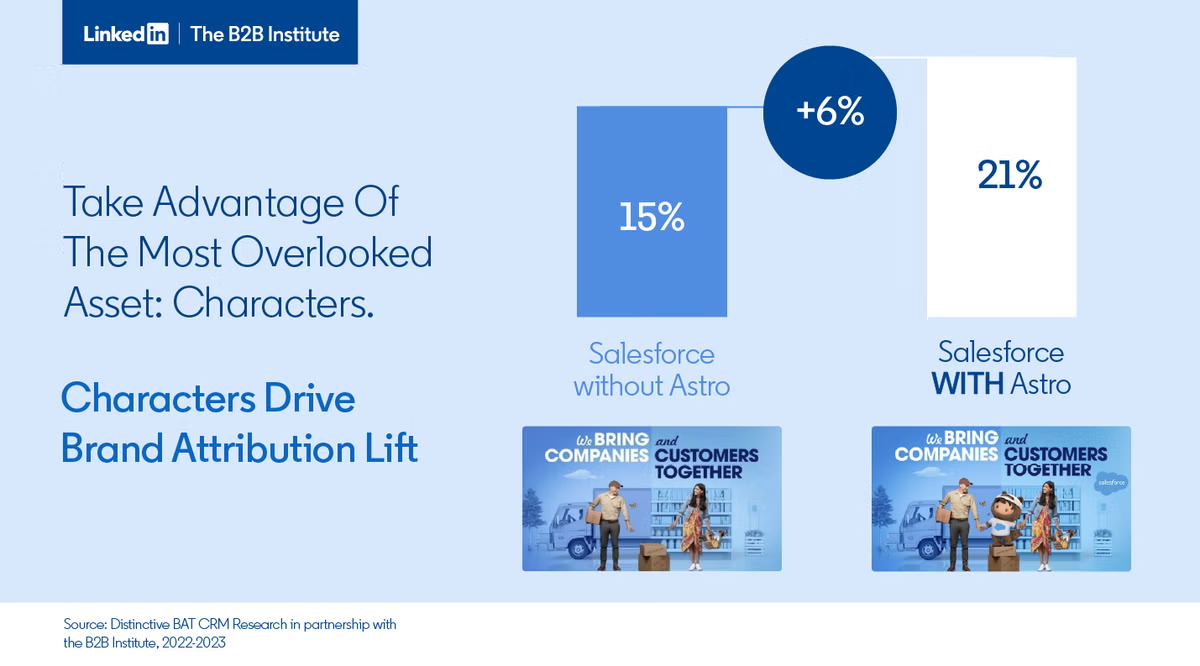
Your marketing machine will have shifted from a mainly performance-focused team to a brand team. Conversations will have shifted from talk of CAC to talk of share of search.
The companies that win here have the highest mental availability in their current and future buyers. Brand for the win.
What this stage feels like: System-based, organised, big bets
Metrics: Pricing power, market share, share of search

.png)